
What “figure-it-out-when-you-get-there” can really cost
Parents spend years preparing for their children to go to college.
They save money. They research schools. They schedule campus visits. They help complete applications, compare financial-aid packages and plan dorm-room purchases.
But one of the most important questions often receives surprisingly little attention:
What kind of work is this student naturally suited to do—and which educational path is most likely to lead there?
Instead, many students enter college with only a vague idea of what they want. Some select a major because they enjoyed a high-school class. Others follow friends, respond to family expectations or choose a field because they have heard it “pays well.”
Then reality arrives.
They discover that they dislike the subject. The required courses do not fit their abilities. The occupation is nothing like they imagined. They switch majors, lose credits, add semesters, transfer schools or leave college before earning a degree.
Exploration is a healthy part of growing up. But at today’s prices, using college as the primary place to “figure yourself out” is an unnecessary and extraordinarily expensive form of career discovery.
One Extra Year Can Cost More Than Many Families Realize
For the 2025–26 academic year, average tuition and fees across U.S. colleges are estimated at about $18,981. When room and board are included, the average rises to roughly $24,148. A broader estimate that includes books, supplies and other living expenses places the average annual cost at approximately $38,270 per student.
The exact figure varies enormously by institution, residency, scholarships and living arrangements. But the larger point is difficult to dispute:
Adding even one unnecessary year to college can easily cost a family $25,000 to $40,000.
And that is only the visible cost.
An additional year may also mean:
- Another year of borrowing
- Another year of interest accumulating
- Another year before the student earns a full-time salary
- Another year without employer retirement contributions
- Another year before the graduate can save for a home or become financially independent
The true cost is not merely what the family pays. It is also what the student gives up.
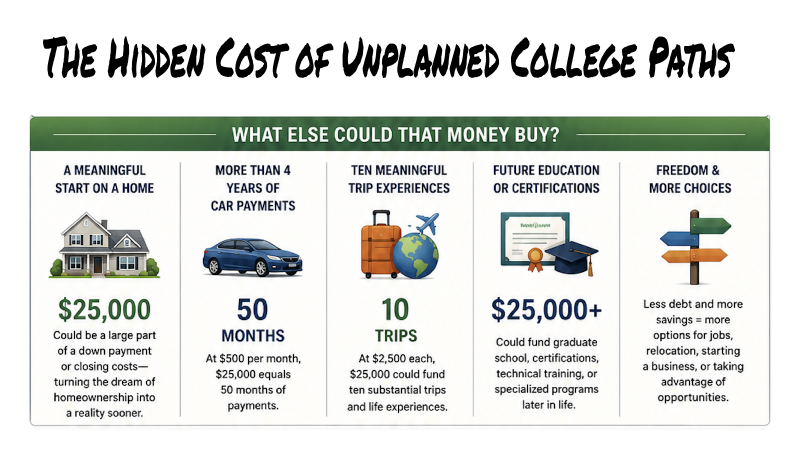
What Else Could $25,000 Buy?
Consider a relatively conservative example: a student’s uncertainty, major changes or unusable credits add $25,000 to the cost of earning a degree.
That money could represent:
A meaningful start on a home
A $25,000 sum could provide a substantial portion of a future down payment, help with closing costs or reduce the amount a young adult must borrow.
For many graduates, homeownership feels impossibly distant. Yet some families unintentionally spend the equivalent of a down payment correcting educational decisions that might have been better informed from the beginning.
More than four years of car payments
At $500 per month, $25,000 equals 50 months of payments—more than four years.
That could mean reliable transportation without a large loan hanging over a new graduate’s budget.
Ten meaningful travel experiences
At $2,500 each, $25,000 could fund ten substantial trips.
That is not an argument for choosing vacations over education. It is a reminder that unnecessary educational spending has a real opportunity cost. Families are exchanging other life experiences and financial goals for that extra semester or year.
Graduate education or specialized training later
A student may eventually need a certification, technical program, licensing course or graduate degree to advance. Money lost through an inefficient undergraduate path will not be available when that later opportunity appears.
The freedom to accept a better first job
A graduate with lower debt and some savings has choices.
They may be able to accept an entry-level position with strong development opportunities rather than simply taking the first job that produces enough income to cover loan payments. They may be able to relocate, complete an internship, launch a business or spend more time finding work that genuinely fits.
Financial flexibility is not merely about comfort. It can shape the entire direction of a career.
The Retirement Cost May Be the Most Surprising
Suppose the same $25,000 were invested at age 22 rather than spent on an unnecessary fifth year of college.
At a hypothetical average annual return of 7%, with the money left invested until age 65, it would grow to approximately $459,000.
Using the higher all-in annual college-cost estimate of $38,270, the potential value at age 65 would be about $702,000.
These are illustrations, not guaranteed investment results. Actual returns, taxes, fees and inflation would change the outcome. But the principle is important:
Money saved early in life has decades of potential growth ahead of it.
An avoidable educational expense does not just disappear from today’s checking account. It may remove hundreds of thousands of dollars from the student’s future financial life.
Here is another way to look at it.
Assume a 22-year-old begins saving toward a retirement goal of $1.25 million at age 65. Assuming a hypothetical 7% annual return, they would need to save $3,793 per year to reach this goal. If they started with an additional $25,000 at age 22 and saved $3,793 per year could allow that person to reach the goal roughly six years earlier than beginning with no initial balance.
That does not mean every unnecessary year of college literally delays retirement by exactly six years. Retirement depends on income, savings, spending, investment performance and many other factors.
But it demonstrates the scale of the decision. A better-informed educational path could ultimately affect not only graduation, but also when a person becomes financially independent decades later.
Changing Majors Is Common—but It Is Not Free
Students should be allowed to learn, grow and change direction. Choosing a career at 17 or 18 should never be treated as an irreversible commitment.
But changing direction has consequences.
Federal education research has found substantial major-changing activity during the first three years of college, with rates varying considerably by field. In some fields, roughly half of students changed majors within that period.
A major change does not automatically add time. General-education courses may still apply, and students who change direction early may remain on schedule.
The risk grows when the new major has a different sequence of prerequisites, when courses do not count toward the new program, when the student changes direction repeatedly or when the student transfers to another institution.
A single change can be productive. A pattern of trial, frustration and repeated redirection can become expensive.
The Most Expensive Outcome Is Debt Without a Degree
The financial value of college is already being debated by families across the country. Tuition has risen, debt burdens remain significant and the economic payoff varies widely by degree, institution, completion status and occupation.
But one outcome is especially troubling: borrowing money for college and leaving without the credential.
Research examining students who began bachelor’s-degree programs found that, after seven years, approximately 30% had ended their studies without earning a degree, with another small percentage still enrolled.
Those students may still carry loans, but they do not receive the full labor-market advantage normally associated with completing the degree.
Student debt is substantial even among graduates. Recent data indicate that about 61% of recent bachelor’s-degree graduates borrowed, and nearly half of bachelor’s-degree borrowers carried balances above $25,000.
Debt without a degree can be far more difficult. The borrower has the monthly obligation but may lack the credential that was supposed to increase earnings and make repayment manageable.
The Problem Is Not That Students Make “Bad” Choices
Teenagers are expected to make one of the largest financial decisions of their lives before they have held many jobs, experienced many workplaces or developed a detailed understanding of hundreds of occupations.
That is a difficult assignment.
They may know that they like biology but not whether they would enjoy the daily realities of laboratory work, patient care, environmental fieldwork or medical sales.
They may be good at writing but not realize how that ability could apply to law, communications, technical documentation, policy, fundraising, research or user-experience design.
They may say they want to “work with people” without understanding the difference between persuading, teaching, advising, serving, supervising and caring for others.
The issue is not a lack of intelligence or ambition. It is a lack of structured information.
Students are often asked, “What do you want to be?” before they have been helped to answer more foundational questions:
- What types of problems do you enjoy solving?
- Which activities consistently hold your attention?
- Do you prefer working with ideas, data, people, systems or tangible objects?
- What work environments bring out your best?
- Which personality characteristics will influence how you perform and interact?
- What are your natural strengths and aptitudes?
- Which occupations fit the combination of these characteristics?
- What education is actually required for those occupations?
Without that foundation, choosing a major can become little more than an educated guess—and sometimes not even an educated one.
Career Planning Should Come Before College Shopping
Families commonly begin with questions such as:
- Which colleges should we visit?
- Where can the student get accepted?
- Which school has the best campus?
- How much financial aid will it offer?
- What should the student major in?
But the sequence should begin earlier:
- Where is this student most likely to thrive?
- Which occupations fit the student’s interests, abilities and personality?
- What education, training or credentials do those occupations actually require?
- Which institutions provide the strongest and most affordable route?
- Only then: Which school should the student attend?
The goal is not to force a teenager to select one permanent occupation.
The goal is to narrow an overwhelming universe of possibilities into a manageable group of promising paths—and to identify expensive mismatches before tuition payments begin.
A Four-Year College Is Not Automatically the Best Answer
A well-informed plan may still lead directly to a traditional bachelor’s degree. For many careers, that remains the appropriate path.
For others, the better route might involve:
- Starting at a community college
- Completing a technical or career program
- Earning an industry certification
- Entering an apprenticeship
- Combining work with part-time education
- Choosing an employer that provides tuition assistance
- Pursuing a targeted credential rather than a broad degree
- Attending a lower-cost institution before transferring
- Delaying enrollment briefly while gaining structured work experience
The objective should not be “college at any cost.”
It should be the right preparation, for the right person, for a realistic career destination, at a justifiable cost.
Clarity Does Not Eliminate Every Risk
No tool or plan can predict a person’s entire future.
People change. Industries evolve. New occupations emerge. A student may discover an unexpected interest or encounter an influential professor, manager or mentor.
Career-planning tools should not place a young person in a box. They should provide evidence that improves the quality of the decision.
Good planning can help students understand their own characteristics, compare compatible career paths, investigate the real work involved and evaluate the education required.
That is far better than selecting a major based on familiarity, pressure, prestige or guesswork.
A Career Plan Costs Far Less Than an Extra Semester
Parents may hesitate to spend money on career planning tools or professional guidance because these services feel optional.
Compared with tuition, they are not expensive.
The relevant comparison is not the cost of planning versus doing nothing today. It is the cost of planning versus:
- An unnecessary semester
- A fifth year of college
- Repeated major changes
- Transferring and losing credits
- Completing a degree that leads to an unsuitable occupation
- Returning to school later for a second credential
- Leaving without graduating
- Beginning adult life with avoidable debt
A relatively small investment in career clarity can inform a decision worth tens—or hundreds—of thousands of dollars. A great career plan might be considered the first step in building family wealth.
How JoFi Helps Families Make a More Informed Decision
JoFi’s career-clarity tools are designed to help individuals identify paths where they are more likely to thrive based on the combination of characteristics they bring to work.
Our tools help students understand the personal characteristics that matter when choosing a career, including their interests, personality, motivations and natural strengths. JoFi then helps them connect those characteristics to careers in which they are more likely to perform well, feel engaged and naturally thrive.
Through JoFi, students can:
- Develop a clearer understanding of themselves
- Discover career options they may never have considered
- Identify careers that value their unique combination of characteristics
- Explore the daily work, environments and requirements associated with different paths
- Compare several strong options before choosing a major or education plan
- Return to their results when their interests, circumstances or the workplace change
That clarity can help families have better conversations about majors, colleges, training alternatives and career goals.
It can also help a student approach college with purpose rather than treating the first several semesters as an expensive experiment.
College is too expensive to be the first step in career exploration.
Learn more about JoFi’s career-planning and career-fit tools at JOFiCareerClarity.com