
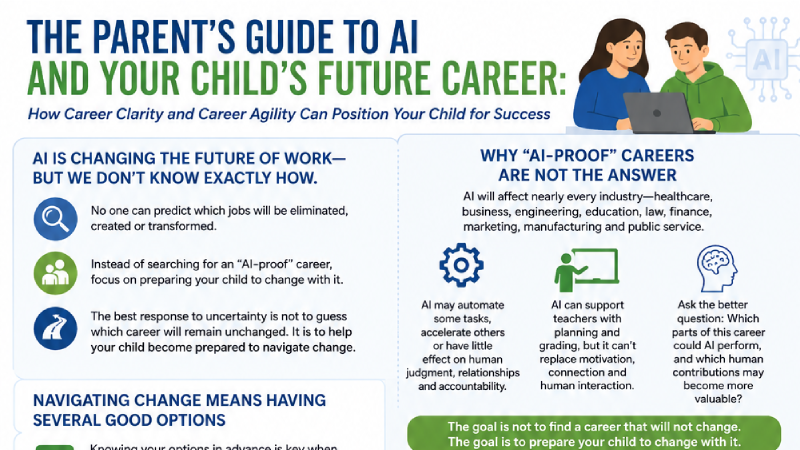
If you are a parent of a high school junior or senior, or a college freshman, your child is amid decisions that will shape the rest of their life.
Which career will provide opportunity, satisfaction and financial stability? Is a four-year degree the right choice? If so, what major at which college is the best path?
Artificial intelligence has made these questions even more complex.
Students hear conflicting predictions about jobs being eliminated, new careers being created and entire industries being transformed. Parents can’t help but wonder whether the career their child chooses will still exist by the time they complete their education.
So…how will AI affect future careers? The honest answer is that no one knows exactly what will happen. But that does not mean families are powerless.
The best response to uncertainty is not to guess which career will remain unchanged. It is to help your child become prepared to navigate change.
Why Searching for an “AI-Proof” Career is Not the Answer
Artificial intelligence is likely to affect nearly every industry, including healthcare, business, engineering, education, law, finance, marketing, manufacturing and public service.
The degree to which jobs will be affected will vary greatly. Most jobs consist of many different tasks. AI may automate some activities, accelerate others and have little effect on responsibilities requiring judgment, accountability, relationships or work in unpredictable environments.
A teacher, for example, may use AI to develop lesson materials or assist with grading. That does not mean AI can replace every aspect of motivating students, managing a classroom and responding to individual needs.
Instead of asking which career is AI proof, the more useful question is: Which parts of this career could AI perform, and which human contributions may become more valuable?
The goal is not to find a career that will not change. The goal is to prepare your child to change with it.
Navigating Change Means Having Several Good Options
Knowing your options in advance is key to navigating change when it happens. This means formal career planning is more important than ever.
For example, students who choose to pursue a four-year degree often spend months researching colleges but very little time researching themselves. Along with their parents, they compare tuition, dormitories, rankings, campus life and location. Those considerations matter, but they do not answer the most important question:
What kind of work is this student naturally suited to pursue?
Without reliable self-knowledge, students often choose majors because a subject sounds interesting, a parent recommends it, a friend selects it or the occupation appears to pay well. Those are not strong enough reasons for a decision that may require years of education and significant financial investment. More importantly, it’s nearly impossible to examine and build a list of options without the information that defines a good option for that student.
Career planning should examine several personal dimensions, including interests, personality, abilities, values and preferred work environments. In evaluating careers it should consider what people in various roles actually do. It should answer questions like:
- What problems does this person solve?
- How much time is spent working with people, ideas, information or equipment?
- Is the work structured or unpredictable?
- Does it require independence, teamwork or both?
- Which tasks might AI change?
- What education is required?
- What does that education cost?
- Are related careers available if the first choice does not work out?
This helps to evaluate options with clear logic: A student may enjoy biology but dislike patient care. They may be interested in psychology but not want to become a therapist. They may enjoy using technology but dislike writing software.
Of course, it’s tempting to jump straight to the AI questions, like which tasks might AI change? But it will be more productive to ask such questions once you have a list of options that you know will be good fits for the student.
Again, the purpose is not to identify one perfect career that will be affected very little by AI. It is to reveal patterns that indicate where the student is most likely to thrive.
Help Your Child Develop Career Agility
Career Agility is the ability to quickly adapt in your career path in response to change, without having to start over or move to a path that isn’t a great fit for you.
Of course this assumes you are on a path that is a great fit already, so it’s worth taking a step back to look at the process of finding and selecting career paths that fit…those in which one will naturally thrive based on their work-related characteristics.
Finding the right path:
Problem: Many people graduate high school and make decisions about their next steps in a sort of “career fog”. With very little information about careers and their own personal traits that would make them a good fit, people choose career paths and college majors based on such things as a friend’s recommendation or a class they liked in high school.
Solution: At JoFi we lift people out of the fog and move them to a state of clarity so they can make great career decisions. The process has two key steps:
- We help them understand characteristics about themselves that are important to finding the right career path.
- We provide a unique and understandable way to navigate thousands of careers, find best-fit options and choose a path.
When someone chooses a path where they can naturally thrive in this informed way, we call that Career Clarity. Their choices are not arbitrary; rather they are based on:
What they learn about themselves:
- What interests them
- What they naturally do well
- What motivates them
- How their personality affects the way they work
What they learn about career options:
- Which careers value their combinations of strengths
- Which careers have environments that help them perform at their best
- What careers include the types of problems they enjoy solving
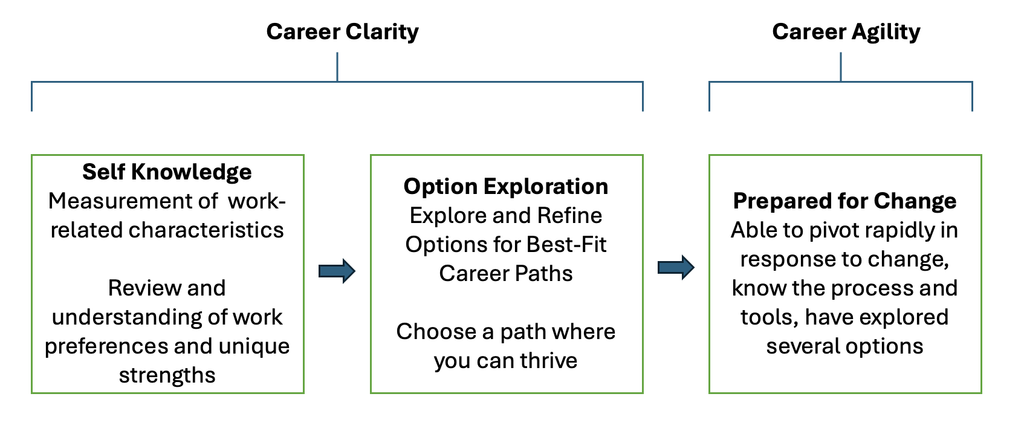
With this context, the definition of Career Agility above likely makes more sense. A person who has been through the process of navigating careers, discovering paths that fit, and narrowing down options, has positioned themselves to be agile when change reveals itself. They already know their own key work-related characteristics. They also know how to navigate careers and options. They can quickly come back to the information and tools they’ve used before to explore various options when necessary. The ability to quickly find, understand, and map out new options that are great fits is what makes them career agile.
This graphic illustrates how the components mentioned above work together
Timing and Other Considerations
Ideally, the steps that help a student reflect, explore, and narrow down best-fit careers should come before major decisions like choosing a career path or college major.
However, these steps are designed for everyone. Career Clarity and Agility are vital to anyone who wants to get on track and stay on track for a fulfilling career, including:
- high school juniors and seniors wanting to find a great path
- high school graduates looking for direction
- college freshmen who are uncertain about their chosen path – or lack of path
- people in careers they don’t feel are a good fit
What AI Knowledge and Skills Should My Child Have?
Unless they pursue a technical career with specific AI requirements, the most important AI skills are:
- Knowing how to use it effectively for productivity
- Understanding its benefits and its limitations
AI may generate information or suggest solutions, but people are still needed to evaluate accuracy, understand context, consider consequences and take responsibility for decisions.
Everyone should learn how to use AI responsibly. They should know how to write effective instructions, verify output, recognize errors, protect private information and determine when human review is essential.
Career benefits will not belong only to those who use AI. It will belong to those who know when to trust it, when to question it and how to use it to produce better work.
The Most Important Takeaways for Parents
AI will change the world of work. The best preparation is not trying to guess every change before it happens. It is helping your child understand where they fit, how to evaluate their options and how to move confidently when new opportunities emerge.
No one can predict exactly how AI will change every career. Some jobs will be transformed, some tasks will be automated, and entirely new opportunities will emerge.
Parents do not need to find an “AI-proof” career for their child. They need to help their child build a strong foundation for making good decisions as the world of work changes.
That foundation includes:
- Understanding their interests, strengths, personality and motivations
- Identifying several career paths in which they are likely to thrive
- Learning what those careers actually involve
- Evaluating the education, cost and opportunities associated with each path
- Developing the ability to revisit and adjust their plans when circumstances change
- Learning how to use AI effectively, responsibly and thoughtfully
A student who understands themselves and knows how to explore careers is better prepared to choose an initial path. Just as importantly, they are better prepared to recognize and pursue new options when technology, employers or their own goals change.
The objective is not to predict the future perfectly. It is to give your child the clarity to choose wisely today and the agility to adapt tomorrow.
How JoFi Helps Students Find Career Clarity and Build Career Agility
Career Clarity helps students make better decisions now. Career Agility helps them continue making informed decisions throughout their working lives.
Our tools help students understand the personal characteristics that matter when choosing a career, including their interests, personality, motivations and natural strengths. JoFi then helps them connect those characteristics to careers in which they are more likely to perform well, feel engaged and naturally thrive.
This gives students more than a recommendation. It gives them a repeatable process for making career decisions.
Through JoFi, students can:
- Develop a clearer understanding of themselves
- Discover career options they may never have considered
- Identify careers that value their unique combination of characteristics
- Explore the daily work, environments and requirements associated with different paths
- Compare several strong options before choosing a major or education plan
- Return to their results when their interests, circumstances or the workplace change
The result is both Career Clarity and Career Agility.
Give your child the clarity to choose a path where they can thrive—and the agility to adapt as the future unfolds.
Learn more at JOFiCareerClarity.com