
This may be the most important article you read this year.
What you need to know now if your child is stuck – not moving forward in life:
- There’s a real solution – with productive steps you can take today
- Your child is not uniquely troubled – this is extremely common
- It’s not your child’s fault
- It’s not your fault
The problem lies in this simple fact:
You and your child are trying to solve a problem, and neither of you have enough information to solve it.
YOU DIDN’T EXPECT THIS
There is a kind of parenting problem no one prepares you for.
Your child graduates from high school, and you assume they will keep moving forward.
You didn’t think they’d have their entire life figured out, but you did expect they’d be moving toward something. And you thought you knew their plan. Maybe the plan was college. Maybe it was to learn a trade. Maybe they planned to start working and discover what they want to do along the way.
Then, somehow, they got stuck.
Maybe your son went to college and is struggling with direction in his first year; maybe he came home after a year because he didn’t know what he wanted to study.
Maybe your daughter graduated from college but is working in a job that has nothing to do with her degree and doesn’t seem to be going anywhere.
Maybe your child is living at home, working part-time, bouncing between jobs or spending months saying they’re “trying to figure things out.”
The child you knew so well seems different. Maybe you can’t describe the change perfectly, but you see them not moving forward; you see their fading happiness. And you’re watching it happen from a few feet away.
You want desperately to help. But you have no idea how.
I understand that feeling because I’ve lived it.
Several years ago, I watched my own child struggle to find direction after high school. I remember his frustration. I remember feeling helpless. I remember wondering what I was supposed to do as a parent when all of the things I normally did to help weren’t helping anymore.
And I remember another emotion I felt but didn’t admit. Many parents I’ve spoken to since shared this emotion and also did their best to hide it.
They felt…embarrassed. Not of their child – but embarrassed that they didn’t know what to do to help. They wondered if they failed their child somehow.
It plays out like this:
You hear that a friend’s daughter just got an internship. A neighbor’s son is graduating from college and has a career job lined up. Someone posts a picture on Facebook of their child’s successes at a new job.
You’re genuinely happy for them. But somewhere in the back of your mind is the thought you don’t say out loud:
Why isn’t my child moving forward like that?
Then comes the even harder question:
What did I do wrong?
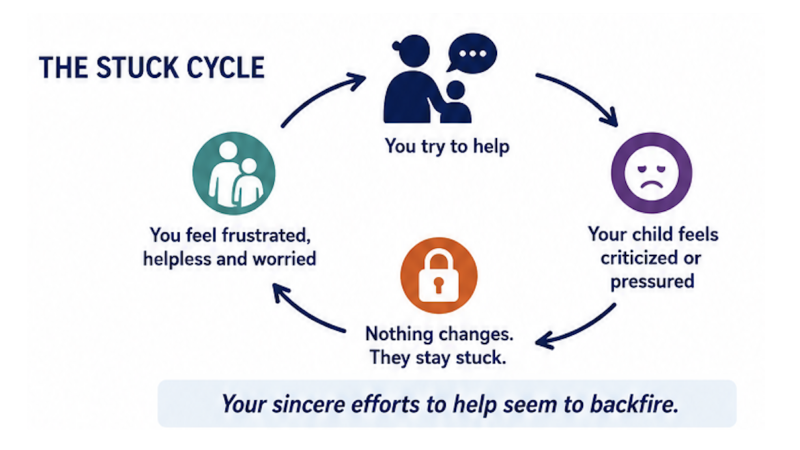
THE CYCLE: YOU KEEP TRYING TO HELP. IT KEEPS GOING BADLY.
When our children are young, helping them is relatively straightforward. They struggle with homework, so we help with homework. They have a problem at school, so we talk it through. They need to learn something, so we teach them.
Then they become young adults, and suddenly the rules change. You can see the problem. You just can’t solve it for them.
So you try to talk, with the intent of encouraging them.
“What are you thinking about doing?”
“Have you applied for any jobs?”
“Have you thought about going back to school?”
“What’s your plan?”
You aren’t trying to criticize them. You’re honestly trying to help because you can see time passing, and you know how competitive the world can be. You know that eventually they need to support themselves.
But somehow, the conversation you intended as encouragement doesn’t sound that way to your child.
They hear: Why can’t you get your act together?
They hear: Your friends are doing better than you.
They hear: I’m disappointed in you.
So they become defensive. Or quiet. Or irritated. And you become frustrated because you’re thinking:
I’m trying to help you.
Eventually, you start avoiding the subject because every conversation ends badly. But not talking about it doesn’t make the worry disappear. If anything, it makes it worse.
I know that cycle well. And now, after years of working with career planning, workforce development and job-fit tools, I understand something I didn’t understand then.
My child and I were trying to have a conversation neither of us had enough information to have.
WHAT BEING “STUCK” IS REALLY ABOUT
People do well if they can.
Dr. Ross Green, child psychologist and well-known author, famously said: “Kids do well if they can”. It turns out, this simple concept holds true for people of all ages and is now a principle widely shared in leadership coaching.
It means that when someone fails to do something, it is typically a lack of know-how or clarity rather than a lack of desire or bad behavior.
To go one step further…when someone doesn’t know WHAT to do to solve a problem, and they are under pressure to solve it, they can completely freeze up.
From the outside, the stuck child’s lack of movement can look like lack of motivation. It’s common for parents conclude:
They just need to try harder.
So, imagine being 20 years old and genuinely having no idea what you should do next.
- You know you’re supposed to choose a direction
- You know your parents are waiting for you to choose one
- You know your friends seem to be moving ahead
- You can feel yourself getting behind
BUT…
- You aren’t taking steps because you don’t know where to start or which direction to go
- You aren’t sure what you’re particularly good at that applies to a career
- You don’t know what kind of work you would enjoy
- You don’t know what careers might fit you
- You don’t even know what many of those careers are
AND…
You’re terrified of making another wrong choice.
That’s not lack of motivation. It’s more like paralysis…and it’s likely a familiar feeling for most parents who’ve experienced something like it at work or in other life situations where they simply did not know what to do.
YOU NEED MORE INFORMATION TO SOLVE THE PROBLEM
We want young people to “figure out what they want to do,” as if they have enough information to even guide them to a general path.
But how would they know? Unfortunately, very few students are truly taught about careers and their own personal characteristics that indicate where they would naturally thrive. They lack useful and vital information about careers and about themselves.
Career Information
Most young adults have been exposed to only a fraction of the careers that exist.
They know what their parents do. They know what their friends’ parents do. They know about highly visible careers such as doctor, lawyer, teacher, engineer, nurse, accountant and software developer.
But the world of work is enormous.
There are occupations involving data, healthcare, technology, manufacturing, skilled trades, design, logistics, communications, engineering, science, finance, public service and hundreds of specialties most teenagers have never heard of.
You can’t choose a career you don’t know exists.
And even if young adults knew about every career available, there is another problem.
Most don’t yet fully understand themselves.
Personal Information
When my son was struggling, I focused too quickly on the question:
“What are you going to do?”
Today, I’m aware that I really needed a detailed answer to:
“Who are you?”
Not philosophically…practically.
What I really needed to understand about my son was:
- What kinds of problems does he naturally enjoy solving?
- Does he gain energy from working with people or prefer working independently?
- Does he like creating things? Analyzing things? Organizing things? Building things? Persuading people? Helping people?
- Is he energized by variety or comfortable with routine?
- Does he thrive in structured environments or when he’s given independence?
- What interests come naturally to him?
- What personality characteristics shape the way he works?
Then to help him get unstuck, we needed a way to compare his characteristics to characteristics required to succeed in actual jobs.
Several years ago, I didn’t have good answers to those questions about my own child.
And neither did my child.
Today, I know there are tools that can help answer them.
CHANGE THE CONVERSATION
Good job-fit tools use assessments to identify characteristics that influence the kinds of work a person may naturally enjoy and perform well.
Measures of career interests and personality, for example, can identify whether someone gravitates toward activities involving things such as investigation, creativity, leadership, helping people, organization or hands-on work.
Personality measures can provide insight into characteristics such as conscientiousness, sociability, curiosity, adaptability and other tendencies that affect how someone operates in a work environment.
Other tools can measure how people think.
Those characteristics can then be compared with data about occupations.
Professional career coaches can help your child understand the data about themselves and about careers at a deeper level.
Suddenly, you have something you didn’t have before: objective information.
That word—objective—is important. Because when a parent tells a child: “I think you’d be good at sales,” the child hears the parent’s opinion.
When a parent says: “You’ve always been good with computers,” the child may hear another suggestion about what Mom or Dad thinks they should do.
But when scientifically validated tools reveal a pattern of characteristics and highlight careers that align with those characteristics, neither person has to defend a personal point of view. The information becomes objective, and that can completely change the conversation.
From Confrontation to Curiosity
Imagine sitting down with your child and looking at career matches together.
Instead of asking:
“What are you going to do with your life?”
you can ask:
“This says these careers match some of your strongest interests and personality characteristics. What do you think?”
Instead of:
“You need to find a better job.”
you can ask:
“Which of these careers sounds interesting enough to learn more about?”
Instead of:
“You need to go back to school.”
you can ask:
“If this career interests you, what education would you actually need to get there?”
Those are very different conversations.
The pressure comes down.
The curiosity goes up.
Your child can disagree with the results.
That’s okay.
In fact, even disagreement can be useful.
“There’s no way I’d want to do that job.”
Why?
“I’d hate sitting at a desk all day.”
Great.
You just learned something.
Or:
“I’ve never heard of that career before, but it actually sounds interesting.”
Now you have something worth investigating.
Career exploration stops being one overwhelming question about someone’s entire future and becomes a series of smaller questions.
What looks interesting?
Why might it fit?
What doesn’t fit?
What would it take to get there?
How could we test it?
Those are questions a stuck young adult can actually answer.
Find out more about getting your child unstuck at JOFiCareerClarity.com