
RESEARCH BRIEF – Emotional Toll on Parents and Families
When Your Child Feels Stuck, the Whole Family Can Feel It
Worry is an expression of care. The challenge is turning that worry into support without taking ownership of the decision.

Families often carry two pressures at once: concern for the young person’s well-being and concern about the time and money attached to the next decision.
Parents’ worry is common—and future plans lead the list
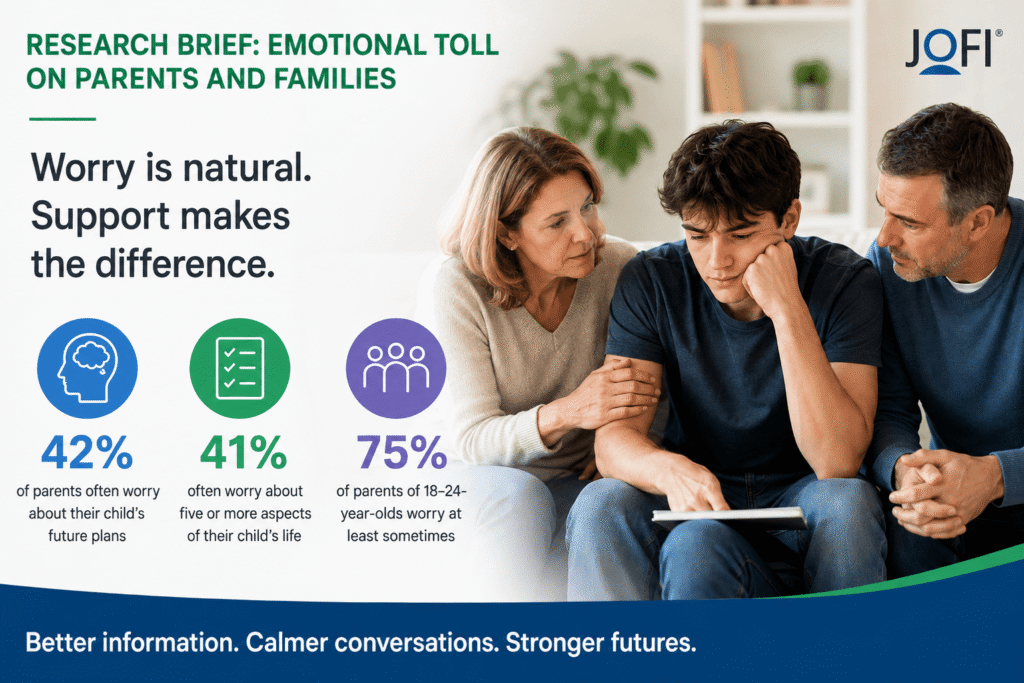
In a 2024 Gallup survey of 1,675 parent-child pairs, 80% of parents said they often or very often worried about at least one aspect of their Gen Z child’s life, and 41% worried about five or more topics. Future plans ranked first at 42%, followed by mental health, school experience and physical safety at 40% each (Gallup and Walton Family Foundation, 2024).
The feeling continues into young adulthood. Pew found that 67% of parents of 18- to 34-year-olds worried at least sometimes about how their child’s life was going; the share was 75% among parents answering about an 18- to 24-year-old. Seventy-one percent said their child’s successes and failures reflected on their own parenting at least a fair amount. That can quietly turn a young adult’s uncertainty into a parent’s sense of responsibility or self-judgment (Pew, 2024).
Financial exposure raises the emotional stakes
The Federal Reserve reports that 16% of U.S. adults had outstanding student loans in 2025. Among adults with student loans, 28% had debt from financing a child’s or grandchild’s education. Twenty-three percent of adults with student debt reported recent payment difficulty. These figures do not say that every family loan is burdensome, but they explain why parents and grandparents may feel urgency when a student is struggling or directionless (Federal Reserve, 2026).
Care can accidentally sound like pressure
Urgency can sound like advice, deadlines, comparisons or attempts to solve the problem. A small qualitative study of young women who experienced parental career pressure found frustration, confusion, anxiety and reduced control. It is illustrative, not representative; the practical point is to keep the young person’s ownership intact (Corey and Chen, 2019).
Support without taking over
A calmer conversation sequence
- Listen before advising. In Gallup’s survey, 62% of children wanted parents to listen when they were upset; 28% wanted advice.
- Ask permission: “Would you like me to listen, help organize the problem or suggest options?”
- Separate the conversations. Career fit, academic performance, mental health and the family budget may need different helpers and meetings.
- Use neutral evidence and agree on one small next step—an assessment debrief, advising appointment, informational interview or course review.
- Protect ownership. Parents and grandparents can fund exploration and open doors; the young person evaluates the evidence and decides.
| The grandparent role Be a calm third voice: share varied career stories, sponsor exploration and ask curious questions. Avoid advocating for one path before the young person has explored alternatives. |
Know when career planning is only one part of the response
A sudden academic decline, withdrawal, persistent sleep or mood changes, substance concerns or talk of hopelessness deserve qualified campus, medical or mental-health help. Career planning should complement—not replace—academic, financial or clinical support.
How JOFI can help
| Structured evidence—not a verdict JOFI gives families a shared language for discussing Career Interests, Personality Traits and occupations worth exploring. Reports and Tools structure the evidence; coaching can help turn it into action. JOFI does not diagnose, guarantee a result or take the decision away from the young person. |
Start with better information. Explore JOFI Career Clarity.
Sources and research note
Research note: Survey findings describe group patterns, not every family. The pressure study involved 20 Canadian undergraduate women and is illustrative, not nationally representative. Financial and mental-health concerns require specialized support.
1. Gallup and Walton Family Foundation (2024). Parents Avoid Hard—but Helpful—Conversations With Gen Z
2. Pew Research Center (2024). How Parents Think Their Young Adult Children Are Doing
3. Federal Reserve Board (2026). Credit: Student Loans
4. Corey and Chen (2019). Young Women’s Experiences of Parental Pressure in Career Exploration