
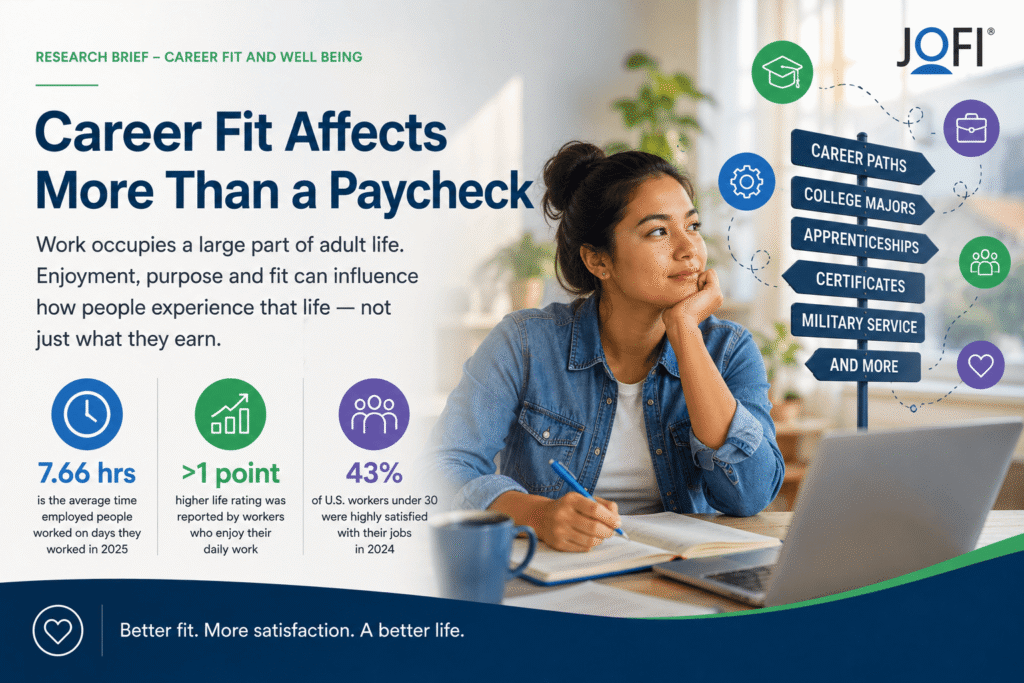
RESEARCH BRIEF – Career Fit and Well Being
Career Fit Affects More Than a Paycheck
Work occupies a large part of adult life. Enjoyment, purpose and fit can influence how people experience that life—not just what they earn.

A career decision is also a quality-of-life decision. That does not mean everyone must find a perfect calling; it means the way work fits the person deserves serious attention.
Work and well-being are closely connected
The U.S. Bureau of Labor Statistics reports that employed people averaged 7.66 hours of work on days they worked in 2025. In a 2026 analysis of more than 350,000 employed adults across 149 countries, Gallup found that people who enjoyed their daily work rated their lives more than one full point higher on a zero-to-10 scale than those who did not. Enjoyment had the strongest and most consistent relationship with broader well-being among the work dimensions studied.
The relationship is not simple cause and effect. Health, income, relationships, job security and many other conditions affect both work and life. Still, the size and consistency of the association make daily work experience hard to dismiss as “just a job.”
Young workers have room for improvement
Pew Research Center found that half of U.S. workers were extremely or very satisfied with their jobs in 2024, but only 43% of workers under 30 reported that level of satisfaction. Pay, supervision, workplace culture and opportunity all matter. So do the daily activities and environment of the work itself.
Fit matters
A meta-analysis covering 105 studies and 39,602 participants found a statistically significant, positive relationship between vocational-interest fit and overall job satisfaction. The relationship was modest and stronger for satisfaction with one’s broader career choice. The researchers emphasized that supervisors, coworkers, pay and the organization also influence satisfaction.
That nuance is useful. Career interests should not be used to promise happiness or prescribe one ideal occupation. Combined with personality information, they can help a young person recognize the kinds of tasks, settings and interactions they may want to seek—or test—before investing in a path.
Look beyond the job title
- What activities make time pass quickly, and which ones consistently drain energy?
- How much interaction, structure, variety, independence and pressure feels workable?
- Would the day-to-day tasks still be appealing after the prestige of the title is removed?
- What small experience could test the fit before a major education or employment commitment?
How JOFI changes the conversation
JOFI Personality Traits and Career Interests provide scientifically validated, objective information about how a young person prefers to work and what kinds of activities tend to engage them. JOFI reports connect that pattern to occupations worth exploring. The results are not a verdict or a single answer; they are a structured starting point for better questions, research and real-world testing.
Start with better information. Explore JOFI Career Clarity.
Sources
1. U.S. Bureau of Labor Statistics (2026). American Time Use Survey—2025 results
2. Gallup (2026). Work Enjoyment Strongly Linked to Overall Wellbeing
3. Pew Research Center (2024). Americans’ Job Satisfaction in 2024
4. Hoff, Song, Wee, Phan and Rounds (2020). Interest Fit and Job Satisfaction: A Systematic Review and Meta-Analysis