
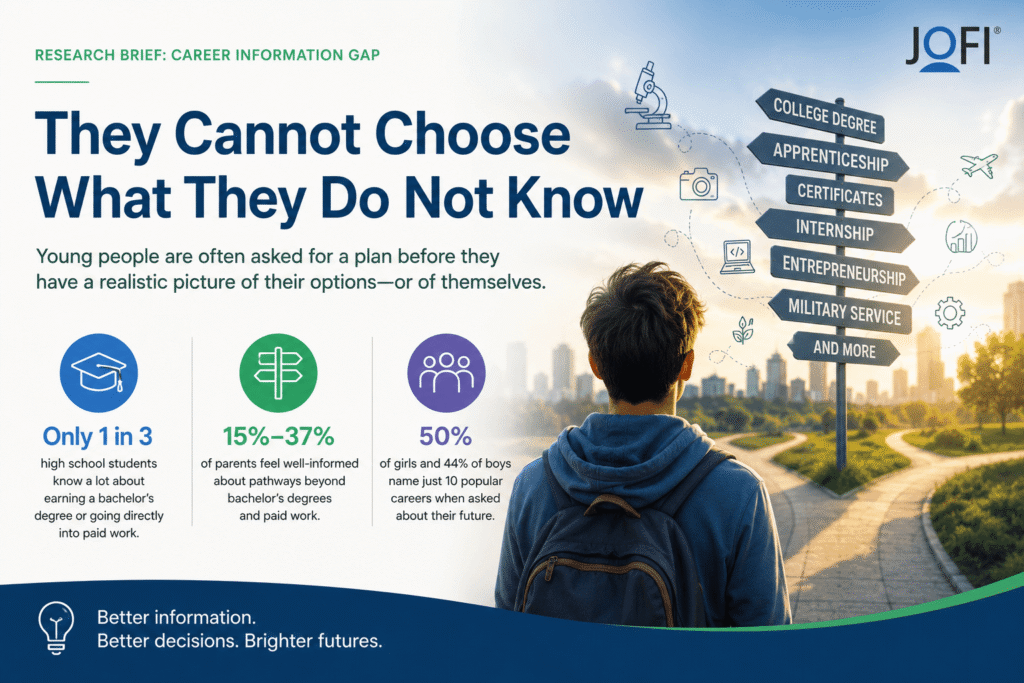
RESEARCH BRIEF – Career Information Gap
They Cannot Choose What They Do Not Know
Young people are often asked for a plan before they have a realistic picture of their options—or of themselves.
Career uncertainty is common. It is also understandable: the world of work is far larger than the slice most teenagers can see.
The information gap is real
A 2025 Gallup study found that only about one in three U.S. high school students knew “a lot” about earning a bachelor’s degree or going directly into paid work. Fewer than one in five knew a lot about any of six other pathways, including associate degrees, certificates, internships, apprenticeships, military service and entrepreneurship.
Parents face the same gap. While 60% felt well-informed about paid work and 52% about bachelor’s degrees, only 15% to 37% felt well-informed about the other pathways. Families may be trying to help while working from an incomplete map.
Familiar careers crowd out invisible ones
The official O*NET taxonomy includes 1,016 occupational titles and more than 56,000 job and alternate titles. Yet OECD data show that 50% of girls and 44% of boys who name a future occupation concentrate on just 10 popular choices. That does not mean their goals are wrong. It means many possibilities never enter the decision.
A plan on paper is not always an explored plan
A U.S. Department of Education study found that 75% of public high school students reported having an education or career plan by spring of 11th grade. Only 22% reported both having a plan and reviewing it at least annually with an adult in school. Simply asking a student to name a future does not ensure they have investigated it.
The stronger question is not “Why haven’t you decided?” It is “What information would help you make a better decision?” Young people need two kinds of information at the same time: a wider view of careers and a clearer understanding of their own work-related interests and personality characteristics.
Questions that create curiosity instead of pressure
- Which activities or problems naturally hold your attention?
- What kind of work setting brings out your best—structured or flexible, social or independent, steady or varied?
- Which unfamiliar careers are interesting enough to research, shadow or test?
- What education or training would those specific careers actually require?
How JOFI changes the conversation
JOFI Personality Traits and Career Interests provide scientifically validated, objective information about how a young person prefers to work and what kinds of activities tend to engage them. JOFI reports connect that pattern to occupations worth exploring. The results are not a verdict or a single answer; they are a structured starting point for better questions, research and real-world testing.
Start with better information. Explore JOFI Career Navigation.
Research note: OECD statistics summarize participating countries and economies; the United States is included in the career-concentration trend. These data describe patterns, not an individual student’s readiness or potential.
Sources
1. Gallup, Walton Family Foundation and Jobs for the Future (2025). Gen Z, Parents Lack Knowledge of Post-High School Options
2. OECD (2025). The State of Global Teenage Career Preparation
3. National Center for O*NET Development. O*NET-SOC Taxonomy
4. U.S. Department of Education, Institute of Education Sciences (2022). Education and Career Planning in High School